
Exploring the connection between art and nature
In class this week we learned about ecological art and how it can connect the students to their immediate environment. While listening to Jan’s lecture, there were a few things that really stood out for me, the number and variety of environmental artists as well as the increased amount of female artists since the 1960s. I know the work of Andy Goldsworthy and Christo and Jean Claude quite well but Jan introduced us to a number of other artists that I had never heard of, Nancy Holt, Smithson, Richard Long, and Alan Wood. This week’s reading, “Art Ecology and Art Education” also introduced me to a number of new artists like Brandon Ballengee, Tiffany Holmes, and Kathy Pendergast. In a class, it would be nice to introduce many artists, females included, so the students can see various ways to incorporate nature in their own art.
For our art making activities in class, we were asked to choose a place outside to create a curriculum activity that involves art making in groups of 4-5. My group walked to the edge of the forest and started planning. We discussed the many cyclical aspects of nature and the importance of relationships in nature. We decided to draw on the latter as we thought it was important to showcase nature’s many relationships and how humans can and should have healthy relationships with nature as well.
For the purposes of this reflection, let’s assume I am teaching this to a grade 9 art class. For assessment of this lesson, I have chosen to focus on 2 different PLOs that have cross curricular value. That being said, this lesson could also be used in a drama 9 class. The PLOs are as follows; Art 9 – Make images in art that solve complex design problems considering form and function. Drama 9 – Make movement choices that create a specific effect.
The activity would be run similarly to how my group mates and I did it in class with a few adaptations. First we would need to scaffold this activity with a lesson on natural relationships. This could start by asking the students what they already know about the topic. As a formative activity, I would use the graffiti wall strategy. Each student would be given 2 or 3 sticky notes and would be invited to take more if they would like. On the sticky notes, students would write about a specific relationship in nature that they find particularly interesting. Some examples might be, mosquitoes and water, as they are hatched in stagnant pools. Another might be wolves and rabbits; if we didn’t have wolves, the rabbit population would be out of control. The students would post their sticky note on a wall and take a look at the others posted. We would follow this with a pair/share guided towards questions that might have come up from the graffiti wall activity.
Next is a community builder exercise I like to call nature’s web. The class of 30 would be broken up into groups of 5 -6. Students are handed a sticky note with an element from nature written on it, for example; rocks, worms, mushrooms, water, flowers, bees and a ball of yarn. Then they have to pass the yarn to another person in the group while explaining a relationship that exists between the two. A web will be created as the yarn can be passed to the same person multiple times but must be passed to everyone at least once.
Next students will pair up and create a physical representation of a relationship or problem that exists between the 2 elements in nature. Students can choose to work with the element they previously used in the web activity or can choose a new one. The form of their body must be considered in the representation. Movement must be used to exemplify the element they are working with. Sound can be incorporated to add function to your representation.
Pair performances are held for the class and we discuss them.
And finally, students are put in groups of 5-6 again and asked to create one visual representation of relationships that exist between all of the partners.
Again we have a discussion, students can guess what the performance was about.
Here is a photo of representations my class mates created.
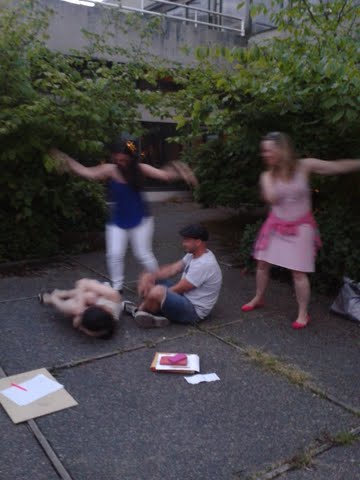
A seagull, rock, waves, and wind.
Recent Comments