Author Archives: Martha

I am a passionate educator, an active artist, a scuba diver, and an otter enthusiast.

Fun with Felting!!!

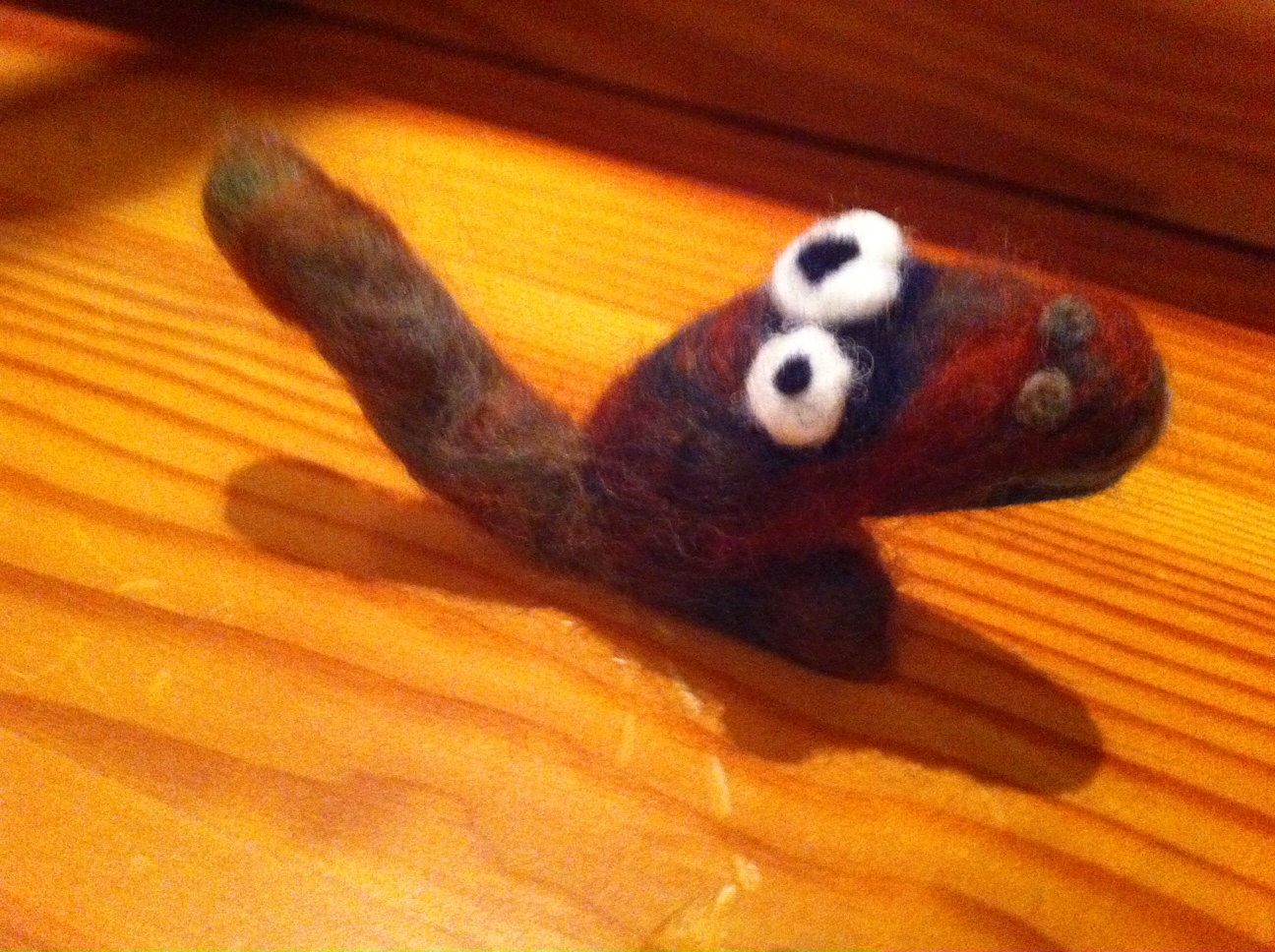
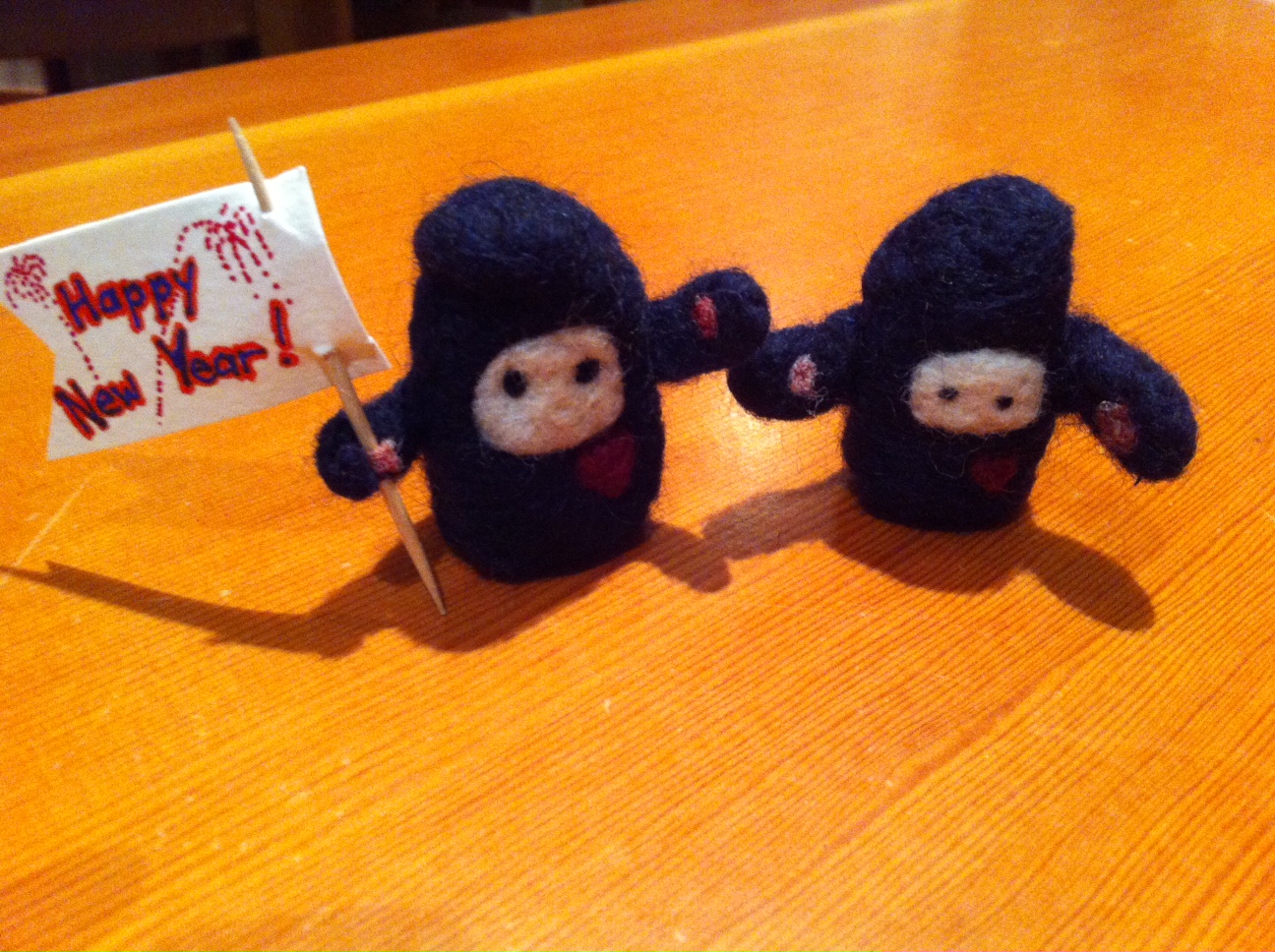
So it’s been a while since I’ve been on here but I have a new hobby and need to post about it. Christmas has just passed here on the Coast and Dave and I had a lovely country Christmas and New Years. For part of my Christmas present, Dave got me all the things necessary for felting; a process where course felt is repeatedly stabbed with a tiny barbed needle which entangles the fibers and gives form to them. There area  a lot of different techniques that I am still learning but here are some pictures of the work Dave and I have created over the holiday season.

One of these little guys made it to our New Years party as a hosting gift.

One of these little guys made it to our New Years party as a hosting gift.


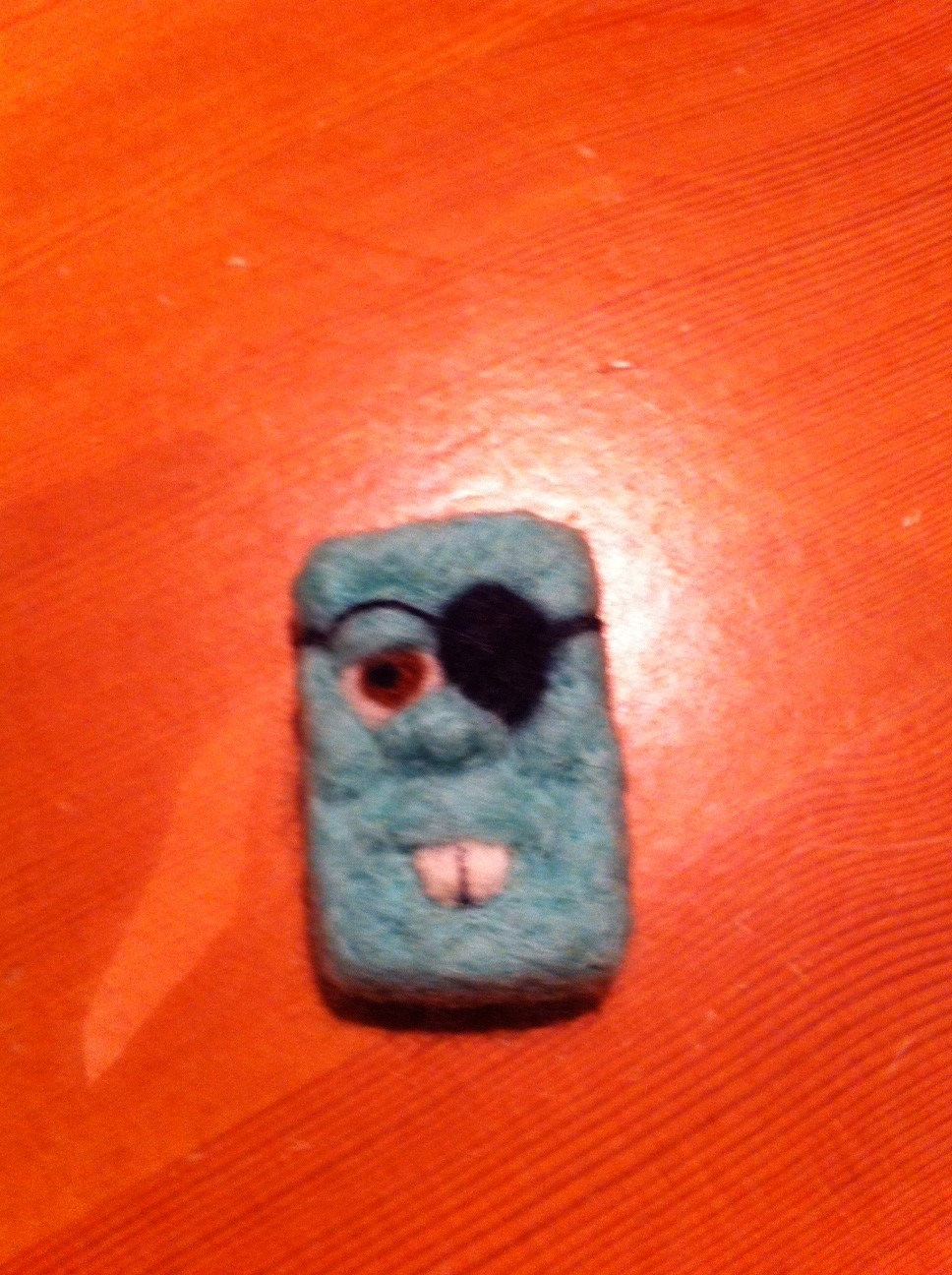
On this little guy I was trying to learn how to do angles and corners. He is only about 3.5 cm by 2 cm and I think this format would make for some nice magnets.

On this little guy I was trying to learn how to do angles and corners. He is only about 3.5 cm by 2 cm and I think this format would make for some nice magnets.

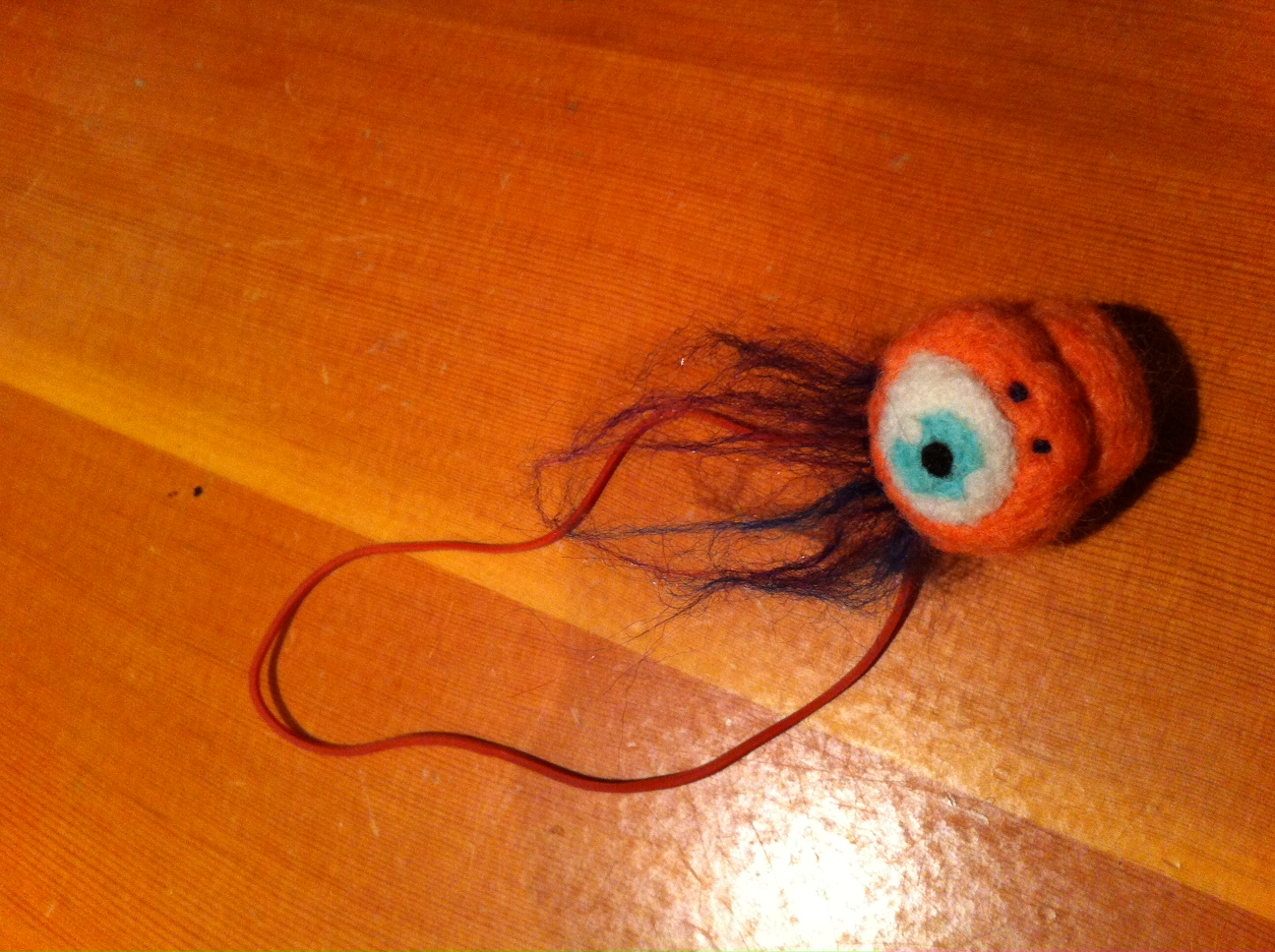
With little Eyeball here I wanted to make something really solid so I worked the form for a really long time to get a firm body. Then I attached an elastic and Dave and I like to fling him around.

With little Eyeball here I wanted to make something really solid so I worked the form for a really long time to get a firm body. Then I attached an elastic and Dave and I like to fling him around


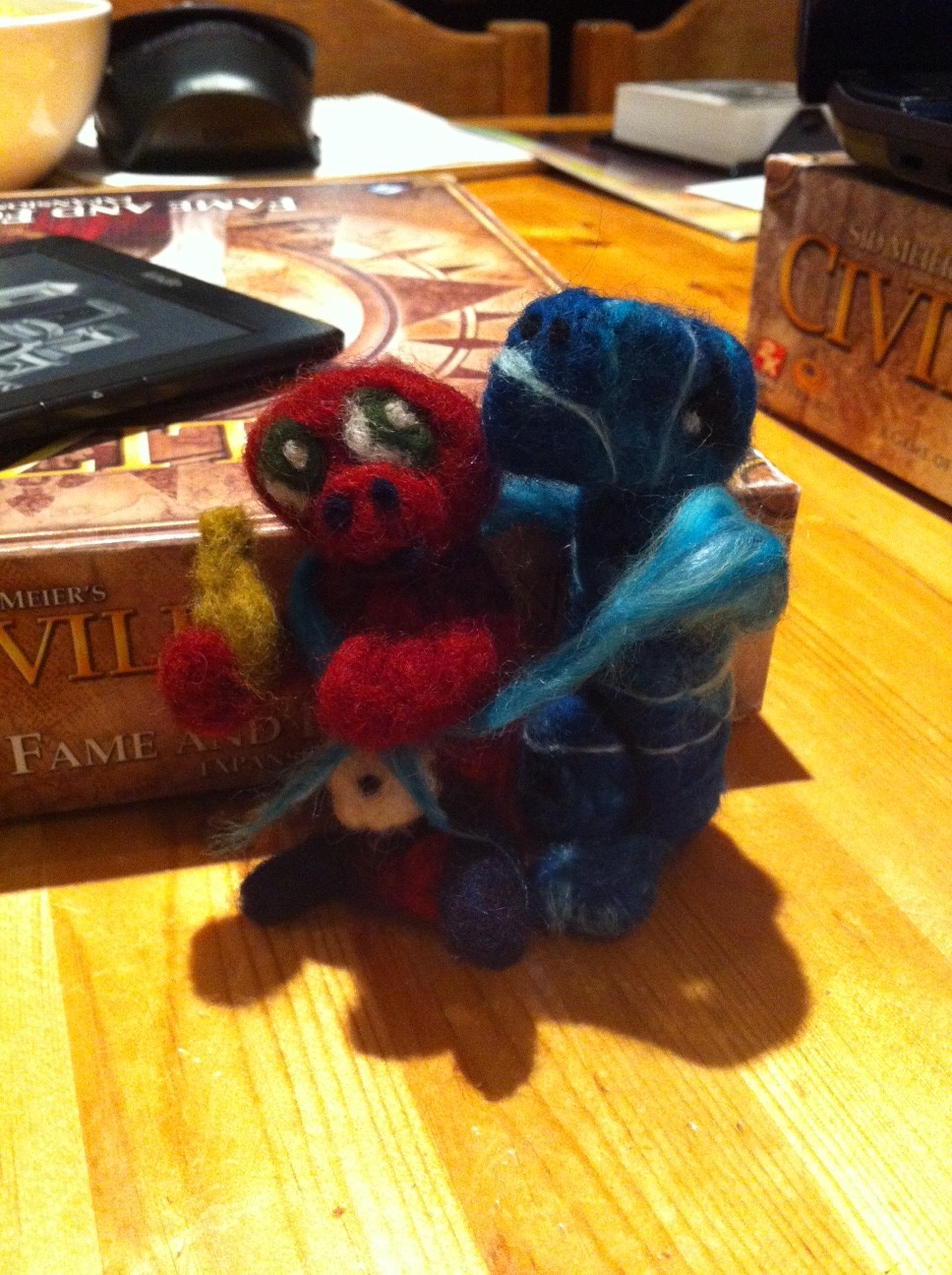
These were our fist attempts and I think they turned out pretty well. I especially like the eyes Dave put on this little red dude.

These were our fist attempts and I think they turned out pretty well. I especially like the eyes Dave put on this little red dude.

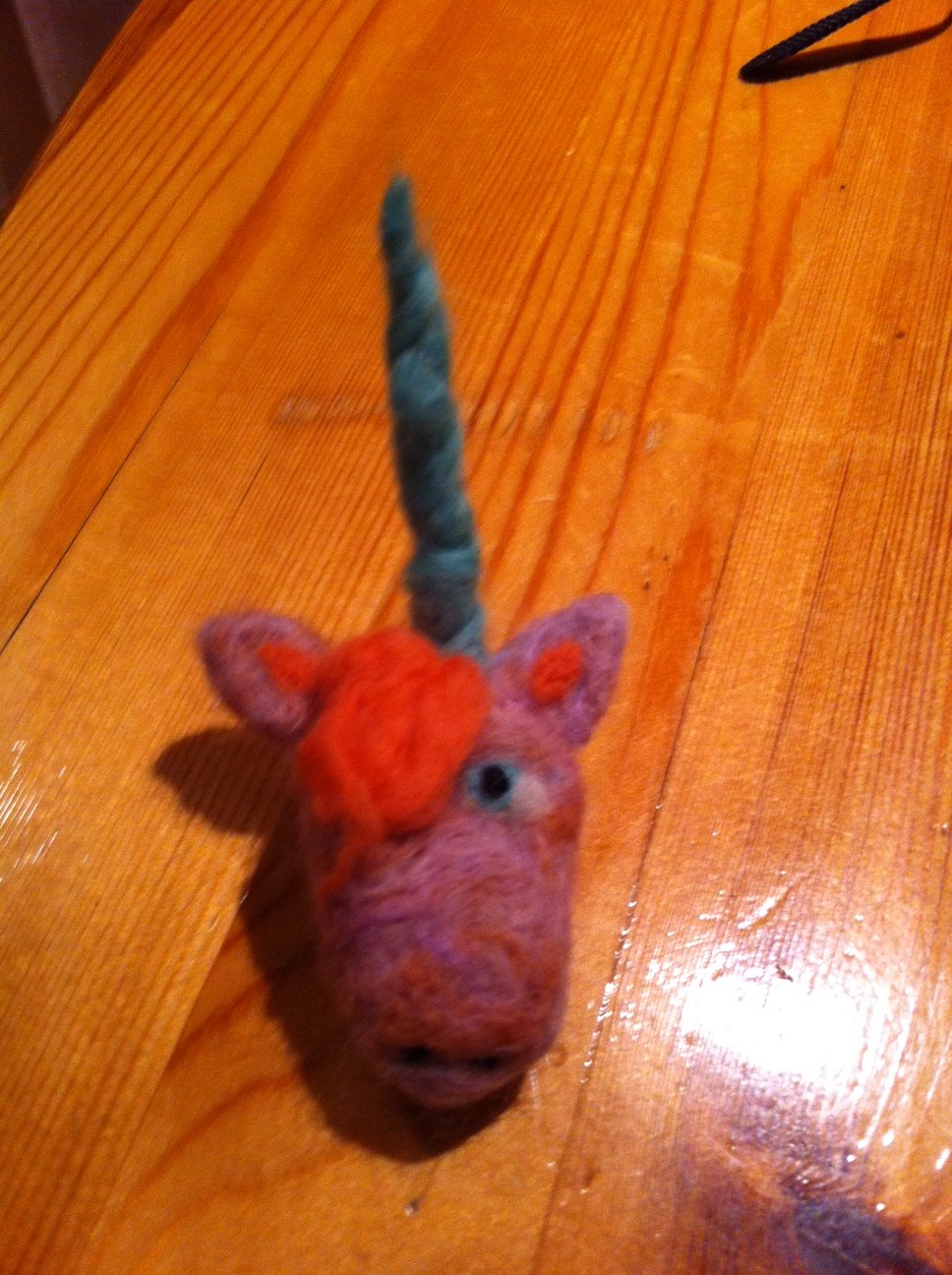
This is the emo unicorn... Inspired by a Halloween costume my mother made me when I was 5. I also felted in a magnet on the back so this guy lives on the fridge.

This is the emo unicorn… Inspired by a Halloween costume my mother made me when I was 5. I also felted in a magnet on the back so this guy lives on the fridge.


Here is one of Dave's creatures... He called him Larry.

Here is one of Dave’s creatures… He called him Larry.


photo (27)


This guy is an Art Spiegelman inspired sheep.

OTTERS AT MY HOUSE!!!!

Holy Hannah!…. I recently moved to the beautiful Sunshine Coast to fulfill my first ever public teaching position (YAY!!!) as a part time art teacher and guess what I found out??? Go on… Guess…. well… there is a family of 5 otters that live AT MY HOUSE!!!!

Hopefully there will be pictures to come 🙂 And of course, there will be art/education related discussions.

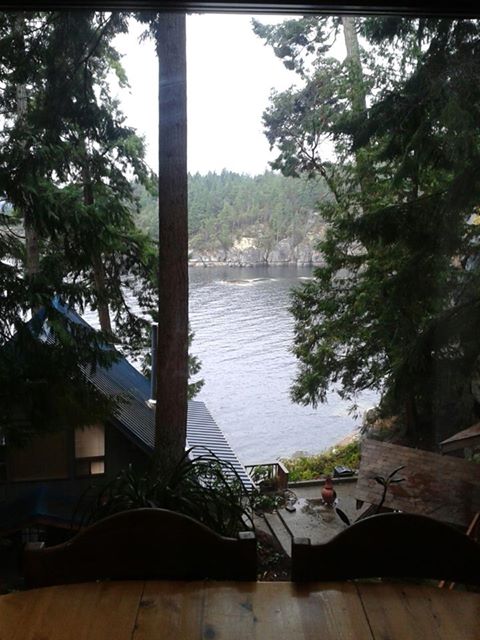
kitchen view


This is the view from my kitchen in Halfmoon Bay BC…  Spectacular! I am so lucky to be working and living in a place like this.

A great resource for decolonizing education in a gentle way!!!

Throughout this year’s PDP journey, my classmates and I have learned a lot about Aboriginal education and the ways we can try to improve education for this growing demographic whom have largely been failed by Canada’s education system.  One repeated thing that pops up often is the idea of decolonizing education by shifting our way of thinking to incorporate multiple ways of knowing something and embracing the traditions of non western education.

Decolonizing Education in a Gentle Way; A Critical Book Review of the Novel Fatty Legs

If you are looking for a detailed account that showcases the extreme hardships and negative ramifications faced by native students who were forced to attend residential schools, then Fatty Legs by Margaret Pokiak-Fenton and Christy Jordan-Fenton may not be the book for you. Though the book is well organized and extremely carefully written for its intended audience, this children’s nonfiction novel describes one girl’s self determination, her struggles with resilience, and her exceptionally strong Inuit spirit while avoiding an exhaustive history of the abusive and cruel realities that accompany many of Canada’s residential schools. Moreover, it is a great classroom resource that can be used to decolonize education by incorporating various strategies taken from Indigenous pedagogy.

Fatty Legs is a true story based on the first residential school experiences of one of the authors, Margaret. The story is told from Margaret’s perspective between the ages of eight and ten and is therefore written using simple and generally positive language in short succinct sentences. Because of the writing style, the book could effectively reach an audience between the ages of five and thirteen with a message that showcases Inuit knowledge and pedagogy and the problems that minorities face in education. It uses maps, illustrations, photography and footnotes describing possibly new vocabulary for such an audience.

Fatty Legs begins with an introduction by Olemaun, which is Margaret’s Inuit name, and displays the thesis of the novel as a story of persecution towards the author/main character and how she overcame the mistreatment caused by being singled out by her oppressor, a nun working at the school. The introduction is followed by a brief description of how many Northern Aboriginal youngsters were often taken from their homes to travel across the ocean to study in, “nests [the outsiders] called schools.” (Pokiak-Fenton & Jordan Fenton, 2010, p. 3). Here the audience gets their first direct reference to colonized education before moving on to Margaret’s personal experiences as the word; “school” is presented as a novel idea. The story is set up nicely with connections to the Lewis Carroll novel, Alice’s Adventures in Wonderland, when Rosie, Olemaun’s half sister who had attended the residential school for four years, reads and explains the story to her in their family tent. This connection is carried throughout the book as the extreme curiosity that both Alice and Olemaun display leads them down a rabbit hole of trouble.

The first chapter showcases Olemaun’s curiosity and determination by depicting the difficult task of convincing her father to allow her to study and learn English at the residential school. After reluctantly agreeing, we follow the Pokiak family away from the safe shores of Banks Island to the hamlet of Aklavik, where the school is and some Inuit families sold pelts and bought yearly supplies from the Hudson’s Bay Company. Olemaun excitedly arrives at the school to find that it might not be as magnificent as she had once expected.  She receives her new name, Margaret, and struggles with her existence at the residential school as she becomes the laughing stock of the other girl residents when she is made to wear an ugly pair of red stockings by a character designated as the Raven. The characters in the book are often referred and compared to different birds which may help the audience visualize their distinct characteristics and displays the Inuit knowledge that Margaret relies on to make sense of her new surroundings.

Margaret overcomes these trials and tribulations by getting rid of her stockings in a bold attempt to defy her oppressor and display her resilience. This resilience is once again tested when Margaret finally reunites with her family after two years away from home.  This difficult reunion is well established in the sequel to Fatty Legs in another nonfiction account titled, A Stranger at Home. The authors display a common story among residential school survivors where feelings of loneliness and isolation take over upon return to their home and family due to the loss of language and traditional knowledge. Fatty Legs flows smoothly into A Stranger at Home carrying over the thesis of strength and resilience in the face of many challenges. “Would you believe that at one point I could scarcely remember my own name or even speak the same language as my mother? Well, it’s true. The outsiders had locked my tongue with the spell of their ‘education’,” (Pokiak-Fenton & Jordan-Fenton, 2011, p. 1). This quote acts as a hook for the second novel and smoothes the transition between Fatty Legs and A Stranger at Home.

Fatty legs is a fantastic resource for teachers to create a safe place to discuss these issues of personal strength, perseverance, and the effects of residential school in terms of colonized education and the indigenous knowledge and pedagogies of the Inuit people. The information is presented in a gentle way to ease the students into what might be their first understanding of the hardships faced by residential school students. As previously discussed, teachers can start to decolonize education by acknowledging the damaging effects of the colonized education presented in the text. Class activities and discussion can be designed around quotes like this one to explore the ideas of power and privilege shifts in colonized education.   “The Raven swooped down and clutched my dress in her claw. ‘This is no place for a wilful child, she hissed’,” (Pokiak-Fenton, & Jordan-Fenton, 2011, p. 50).  As suggested by Lawrence (2009), in the article, “Gender, Race, and the Regulation of Native Identity in Canada and the United States of America”, to decolonize education, teachers must adjust and revise how their students perceive Indigenous identity. This can be done by showcasing the many examples of Inuit knowledge and pedagogy that are woven throughout the book like the lessons Olemaun learns from her father about hunting or the story that he tells her which aligns the effects of the school’s education to the wearing down of a rock on the ocean’s edge, “Do you see this rock? It was once jagged and full of sharp, jutting points, but the water of the ocean slapped and slapped at it, carrying away its angles and edges. Now it is nothing but a small pebble. That is what the outsiders will do to you at the school.” (Pokiak-Fenton, & Jordan-Fenton, 2011, p. 13) This also speaks to the effect that colonized education was meant to strip the Indigenous peoples from their traditions in an attempt to assimilate them into the dominant culture. “For Native people, individual identity is always being negotiated in relation to collective identity, and in the face of an external colonizing society. Bodies of law defining and controlling Indianness have for years distorted and disrupted older Indigenous ways of identifying the self in relation not only to collective identity but also to the land” (Lawrence, 2003, p. 4).  These ideas are wrapped up nicely in the last section titled, the schools, with a current account of how residential school survivors and their families are healing through relearning their cultural heritage, language, and creating dialogue with books like Fatty Legs.

In doing this, the authors have considered the different perspectives that the audience brings in their interaction with the text.  Many of the children who read the book have family members who attended residential school and are still navigating the negative effects of their colonized education. Because of this, it might be difficult for some readers to discuss the realities of residential schools and how they are personally affected. Bombay, Matheson, and Anisman (2011) suggested that, “many survivors returned home with inappropriate behavior patterns, including abusive or neglectful parenting behaviors modeled after the care-giving behaviors witnessed at [Indian residential schools],” (p. 369). It seems as if the authors have taken this into account by steering the story toward personal triumph and away from the negative effects of the residential school experience. This can be seen as a strength of the novel as it demonstrates the careful thought displayed in considering the audience and is in line with the thesis statement of one girl’s spirit and strength. It might be easy to say that the authors didn’t depict the true existence of the children attending the residential school as extremely abusive situations are omitted though this would be imposing one’s thoughts on the intentions of the author.

One thing the audience should be aware of when reading this story is the voices of two authors coming together. Whenever a nonfiction account is retold by two authors, one who experienced the real life situations, Margaret Pokiak-Fenton, and one who did not, Christy Jordan-Fenton, Margaret’s daughter in-law, we must consider whose voice is coming through in the text. Questioning which parts of the text are for literary effects and which are actual past happenings is one way a teacher can bring in the learning outcomes around comprehending literature and its devises. One area in which I question the accuracy of the story and the use of literary devises is the allusion to Alice’s Adventures in Wonderland. The story both begins and ends by aligning Margaret’s curiosity about the outsiders with that of Alice’s when entering the rabbit hole. Perhaps these metaphors were created by the co-author to add literary effect.

When questioning the accuracy of other information presented in the novel, I feel that it aligns with the reality of history. Research by White and Peters (2009) supports, “Children were taken, often forcefully, from their homes their hair was cut, they were clothed in European style of dress, and they were placed in unsanitary living conditions. Students were taught to be ashamed of their culture and to see themselves and their people as inferior and immoral, often facing punishment if they spoke their own language,” (p. 19). Fatty Legs describes these issues in a manageable way for the intended audience to demonstrate what Margaret faced at the All Saints Residential School which was running in Aklavik during the time that she would have attended. Furthermore, the referenced photo documentation at the end of the novel presents real life references to many of the ideas that the authors discuss. Inuktitut Magazine (2000) describes:

By the 1920s, when the earliest of these photographs was taken, they were also meeting southerners there, as Aklavik had become the centre of trapping, trade, and transportation for the Mackenzie Delta. It had a Hudson’s Bay Company store, a police post, and competing Anglican and Roman Catholic missions — each with its own hospital and residential school. (p. 29-34).

After reading the story, I feel that it would be an excellent tool to use in the classroom. It is a magnificent and believable story where the main character struggles to overcome the hardship she experiences in her journey to and within the outsiders’ school. The characters are presented in a realistic way even when being depicted and described as birds. In fact, this depiction embraces multiple ways of knowing and may reach some students more easily than a physical description of the person.  Margaret’s strengths and weaknesses are discussed which readers both young and old could easily empathize with. And through a variety of teaching strategies, teachers can display Inuit knowledge and pedagogy while decolonizing their student’s education and introducing the ideas of multicultural and anti-racist education.

Classroom Methods

In this section, I will examine specific teaching strategies that could be used in conjunction with the text to create a safe place for discussions around difficult topics and to begin the process of decolonizing education. Depending on the age, grade level and subject of the students, some activities may need to be modified but for the purposes of this paper, I will conduct the classroom methods section in respect to a grade 8 drama class.

Decolonizing education can be a difficult idea for someone to embrace if they have only experienced a colonized education. As suggested by Marie Battiste (2002) in her literature review, the act of decolonizing education requires giving power and space for the varied voices of Indigenous peoples. This can be done by first revealing the past and current injustices in Canada’s colonial existence and deconstructing the past to reconstruct the future by analyzing the political, social, emotional and economic reasons for taking away the voices of Aboriginals in history.   Curriculum should be designed to legitimize the experiences and knowledge of Aboriginal peoples while understanding it as an influential and powerful form of knowing, insight and education.

One way to begin the decolonization process would be to have the students read the novel Fatty Legs. This could be done by using a talking circle process where the teacher and students take turns reading from the text. Before beginning the reading process though, some front loading or scaffolding should take place to explain the significance of storytelling to Indigenous knowledge and pedagogies. As Thomas King (2003) suggests, in the absence of stories, one can’t gain an accurate understanding of the world, (p. 32).

Storytelling and oral tradition require active participation by both the storyteller and the listeners. To assess the active participation of the students’ listening skills, the students could develop a dramatic work that explores solutions to some of the problems that characters in the book face. These performances should also promote acceptance of cultural differences. This aligns directly to the following prescribed learning outcomes in the grade 8 Integrated Resource Package (1995); “demonstrate the unique ability of drama to unify a group and demonstrate an appreciation of the diversity of others and their various perspectives” (p. 6). After reading the novel, the teacher should conduct a discussion about the history of education in Canada while guiding the topic to cover the political, social, emotional, and economic reasons for assimilation. This discussion can be introduced by using popular media like the CBC series titled, the 8th Fire or the music video by hip hop duo Rapsure Risin in which the two singer/song writers roam the halls of an empty residential school. Using popular media is a great way to access the students’ previous knowledge about residential schools to make comparisons with the novel.  Following this discussion, students can create a scene related to their new understanding of the history of education using the developed characters from the novel or developing their own unique characters.

To explore the ideas of power and privilege embedded in colonization, one strategy that could be used is to have students create or act out scenes from the novel which demonstrate power struggles between characters like Margaret and The Raven. Students can then reflect on their experience in and out of the role to gain a better understanding of how power relates to personal feelings.

Other pedagogical strategies embraced by Indigenous knowledge are the use of, “participant observations, experiential learning, modeling, mediation, prayer, ceremonies, or story telling as ways of knowing and learning,” (Battiste, 2002). Drama teachers have a somewhat unique ability to deviate from the Eurocentric educational strategy of testing and writing and can base their assessment of student work on a much broader set of strategies like teacher observation, student/teacher conferences, and peer or self assessment. In doing this the teacher is modeling the strategies used in Indigenous knowledge and pedagogy.

The authors of Fatty Legs have done a great job using the life experiences of one strong willed Inuit girl to retell the often brutal history of Canada’s colonized education in a gentle way. This can ease the young readers into an understanding of the hardships faced by residential school survivors and can open up a safe dialogue to discuss these sometimes difficult topics. By exploring this novel, teachers can begin to decolonize education using Indigenous knowledge and pedagogy as a framework to assess Canada’s history, encourage acceptance of multiple ways of knowing, and assess student work in a less Eurocentric way.


References

Battiste, M. (2002). Indigenous knowledge and pedagogy in First Nations education: A literature review with recommendations. Retrieved from http://www.usask.ca/education/people/battistem/ikp_e.pdf

Bombay, A., Matheson, K., & Anisman, H. (2011). The impact of stressors on second generation Indian residential school survivors, Transcultural Psychology, 48 (4), 367-391.

Inuit Tapirisat of Canada, (2000). A look back at Aklavik, Inuktitut, 86, (29-34).

King, T. (2003). The truth about stories. Toronto, ON: House of Anansi Press.

Lawrence, B. (2003). Gender, race, and the regulation of Native identity in Canada and the United States of America: An overview, Hypatia, 18 (2), 3-31.

Ministry of Education, (1995). Drama 8-10: Integrated resource package. (IRP 017) Province of British Columbia.

Pokiak-Fenton, M., & Jordan-Fenton, C. (2011). A stranger at home. Buffalo, NY: Annick Press.

Pokiak-Fenton, M., & Jordan-Fenton, C. (2010). Fatty legs. Buffalo, NY: Annick Press.

White, J.P., Peters, J., Beavon, D., & Spence, N., (2009) Aboriginal education: Current crisis and future alternatives. J. P. White & J Peters (Ed.) . Toronto, ON: Thompson Educational Publishing, Inc.

I’m always adapting my educational credo

For my curriculum development class I was asked to write a fictional-esque story where I am the hero somehow working towards implementing curriculum changes based on my developing ideas about the educational philosophies that drive my personal credo. Here is what I came up with. Dave said it was Atwoody…nI’ll take that as a compliment of the highest regard 🙂


011011010111100100100000011000100110000101110100011101000110110001100101

By Martha Beardsworth

In the beginning, we were all the same. At least that is what we thought because that is how we were being designed. Of course there were anomalies, those subjects disappeared and never came back. And of course, some subjects experienced malfunctions along the way and were pushed to the side to make room for more of us. I guess the beginning wasn’t so different from the present, I just know how to fight it now, from the inside.

When I was in The (i)nstitution, some of us were being groomed for The Big Institute while others were being prepared for The Big Real. When the masters prepared us, they used carbon copies to guide their motives and each department of the (i)nstitute worked separately. There was no difference between how we were prepared. Most everyone got promoted but some were allowed to enter different departments depending on their task performances.

I was a lucky one. I had access to all of the departments but some weren’t very appealing. I didn’t think they would help me in The Big Institute or The Big Real. I was programmed early on, even before The (i)nstitution,  to exist in the creation department so that is where I spent most of my time when I was stuck in The (i)nstitute. I found that the creation department gave me and the others who attended, a small amount of freedom to be different. It was too bad that all the departments weren’t like that. I knew other subjects who were programmed to be in other department but wanted so badly to be different, however they just weren’t programmed to exist in the creation department. Spending most of my time in the creation department, I got to see how the master in this department was different than the other masters too.

It was him who guided me to The Big Institute where I was zoned solely to the creation department. I only had to spend minimal time locked down in other departments but my time in those departments allowed me to work effectively in the creation department by giving me insight into the theories and ideas embedded in the department programs.  I used this information in my explorations for the creation challenges and tasks. Four years I spent in The Big Institute and by the end, I was ready for The Big Real. Or at least I thought I was.

When I went into The Big Real, I took a huge challenge and became a master in a foreign Real. My existence there was completely different from my previous time in my original Real. In the foreign Real, everyone transmitted their information completely differently. It was like they used twos and threes instead of zeros and ones. Not only was the information transmission system different, the entire (i)nstitution set up was different. I thought I was there to program the subjects so they could accomplish their challenges and successfully complete tasks. This was incorrect. I was there to further the (i)nstitution’s capitol. All they wanted was more capitol and because of this, challenges and tasks didn’t even matter. After spending two years in the foreign Real, I realized that my creation skills weren’t being used. Furthermore, I wasn’t doing what I had set out to do; give value to differences among subjects. However, I also determined that I wasn’t yet prepared to undertake this crusade. I needed to go back to The Big Institute to train for battle.

When I came back to The Big Institute, I joined a new department and now I am finishing my final challenges for the year long duration. This department is specifically designed to train masters to program subjects. Looking back, I can see that I was lacking these skills in the foreign Real and may have even damaged some of my subjects there with hidden viruses in the programs I bestowed on them. I am not proud of this but now know that The Big Institute has wiped these viruses from my circuit board so that it won’t happen again.

Let me convey to you the programming changes I went through at the Big Institute. When I began the programming sessions for new masters, I came equipped with old programs that I received in The (i)nstitute and The Big foreign Real. These programs weren’t sufficient in the new Big Institute. The new Big Institute wasn’t addressing capitol as was the foreign Real and it seemed that at the new Big Institute, programming difference in subjects was encouraged. Finally, I was acquiring information about programming the subjects to value their differences. My new masters called this differentiated instruction and it aligned with my objectives of allowing my subjects to embrace the differences in the way their circuits functioned.  Listening to my new masters, I realized that I was in the right Institute and started to feel the viruses leave my circuit board.

During my first term at The Big Institute, my masters changed my programming completely by showing me the ways of differentiated instruction. These two masters helped me rearrange my circuit board so that I was wired to instruct in a differentiated manner. They displayed new theories from various renowned masters. Daily, I would practice these theories on the other masters in training and use the information gained from the practice sessions to determine my new master objectives. I wrote and designed many reflections on this new information which allowed me to learn from my emotional responses to the new approach. What I learned from my reflections was that my challenge to implement value in subject differences had just begun and was about to get much more complicated as I learned about the practical applications of differentiated instruction during what is known as a long practicum.

My experience in the practicum was at times joyous and at others, tumultuous. All of the information I had gained from practice sessions and practical reflections in the previous term only showed me a glimpse of the reality that masters in (i)nstitutions face every day when dealing with differentiated subject needs. I prepared to address the needs of my subjects by reading extensive documents about them and trying to determine how to best support their individual needs. One of the major practical lessons I learned was that other masters in The (i)nstitutes are usually interested in helping newer masters and are great resources for accessing tested (i)nstitutional practices. However, there is only so much one master is willing to do for another at an (i)nstitute. Nearing the intersection of the practicum, I started to become unhinged. There seemed to be too many differentiated needs for all the subjects. Some needs contradicted those of others and dealing with these differences almost made my circuit board burn out. This couldn’t be right. There had to be more tools to help masters lead their subjects to success in (i)nstitutes, Big Institutes, and The Big Real.  I finished the practicum and was successful in programming an appreciation of differences in many of my subjects but I knew my challenge wasn’t finished there. I needed those other tools and hoped to find them in the last phase of the master in training department.

In the final term of The Big Institute, I entered a technological department that The Big Institute titled EDUC471 C100.  This department challenged me to think of my subjects in a different way. The department provided me with information about institutional aims and philosophies that I had never accessed before. Other masters in training and I transmitted information back and forth about the relevance of these aims and how and why they should be applied to subjects in (i)nstitutes. These transmissions developed my new programs to embrace many aspects of the institutional aims. It seemed at first that the most important aim was to prepare the subjects for The Big Real. I conducted a challenge about this aim where I examined how to prepare subjects for The Big Real in the face of Big Real environmental issues. Through this challenge, I came to a new understanding and saved it to my database. My ultimate challenge was to prepare subjects to deal with future Big Real environmental pressures by connecting them to their immediate environment and community while embracing their differentiated needs.  Furthermore, as the future of The Big Real is advancing so quickly, programming technology into the subjects is also imperative as it is apparent that the future of The Big Real is wrapped in technology. However, I also need to embed a curriculum that programs character development, flourishing, and critical computation into my subjects.

Looking back at my time as a subject in my first (i)nstitute, I can see that there was a major connection problem between masters and subjects. The masters didn’t take the necessary time to upload the interests of the subjects into the program tasks and challenges. Ultimately, the curriculum of any program needs to be designed around the interests of the subjects. If the subjects aren’t engaged with the program materials, their information downloading systems won’t save to their database. Subjects also need to trust their masters and gaining this trust is the first step to implementing the institutional aims of character development, flourishing, critical computation, environmental sustainability, and increased technological understandings. Gaining subject trust can be done through transmission of ideas, goals, and expectations on both the part of the master and the subjects in the beginning of a new term. When a master places value in the individual ideas, goals, and expectations of each subject, the subjects will begin to embrace their differences and the differences of their peers. When I finish my time at The Big Institute, I will enter The Big Real by working for an (i)nstitute. At this (i)nstitute, I will establish connections with my subjects by listening to them and applying their needs and goals to the curriculum I design. I will encourage authentic inter-subject connections by embracing the differences that each of my subjects is programed for. For example, some subjects may be foreign and may need a conduit to transmit what is relevant in their original Real and therefore relevant to them. It is my job to provide this conduit by designing lessons and challenges that allow the subjects to explore their connections to their peers, community, environment, society, technology and to themselves.  If I can’t lead my subjects to embrace and develop ideas about these connections, they will not be prepared for the increasingly Global Big Real.   Developing self actualizing abilities in my subjects in relation to others, technology, and the environment is the paramount challenge I face as a newly trained master.

When I was just a young subject in my first (i)nstitute, I struggled to be acknowledged for my differences and wished that my peer subjects could be as well. As a trained master, I will fight to reform curriculum practices at my (i)nstitute so that all departments embrace subject differences, not just the creation department though that is where I will begin my reform challenge.  I will work with masters in other departments to model cross curricular programing for the subjects which will encourage character development by showing flexibility and collaboration. I hope this will generalize to my subjects’ participation in The Big Real. I will increasingly incorporate technology in my program’s curriculum to transmit its importance to the future of The Big Real and the subjects’ lives. And I will do all this by connecting my subjects to their immediate environment and community in a way that embraces and values their differences.

In the beginning, we were all the same because our masters gave us all the same challenges and prepared us for The Big Real with little deviation from their carbon copy programs. From now on, I am going to break this standard by working within the (i)nstitute to reform the ideas of other (i)nstitutional development specialists, masters, subjects, and community members by designing my programs around my subjects. Challenge and task assessments will no longer be designed with one standard. The students will build on what they already know as I will design my curriculum around their interests by offering them choices.  Environmental sustainability will be a continuous theme throughout my programs and the subjects will upload this information by using new technologies that will better prepare them for The Big Real.

In the end, my subjects will know and value their differences and this will lead them to success in The Big Real.


Infographic 3 lesson Unit Plan-Grade 9

For my final assignment in my Numeracy in Society class I was asked to create a unit plan incorporating the ideas and lessons learned from the numeracy class into my teachable subject area. After some brainstorming with my partner, I decided to go with infographics which are visual representations using carefully calculated design elements to make the data being conveyed more easily understood. Honestly, I think this cross curricular unit plan should be stretched out into 4 or 4.5 lessons so the students get a better understanding of what infographics are, why they are used and how it applies to graphic designers and artists as well as the critical thinking needed to decipher data today.

Unit plan and supplementary materials- Infographic Unit Plan

Lesson 1 – Intro to Infographics

Lesson 2 – Data accuracy and critical thinking

Lesson 3 – Studio class


Oops, I forgot one.

The following images came out of my quick write activity. You can probably see influences of the quick write in the GIMP images I played with too.

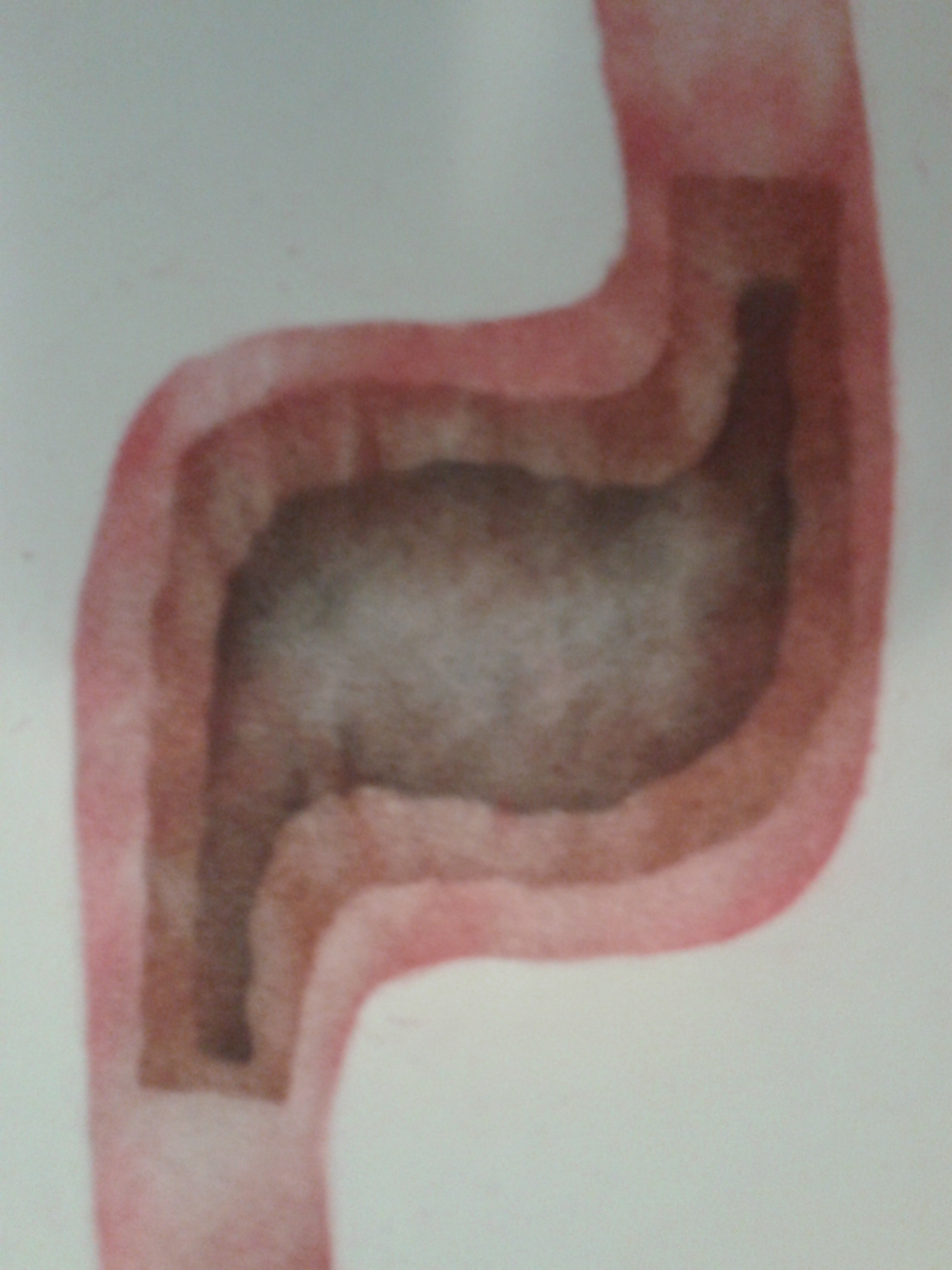
I created an image of a stomach as a visual representation of the jittery feeling I get in my gut when I feel anxious or stressed… Subsequently, I didn’t experience an of that in the creation of this piece 🙂 It’s a very pleasant process.

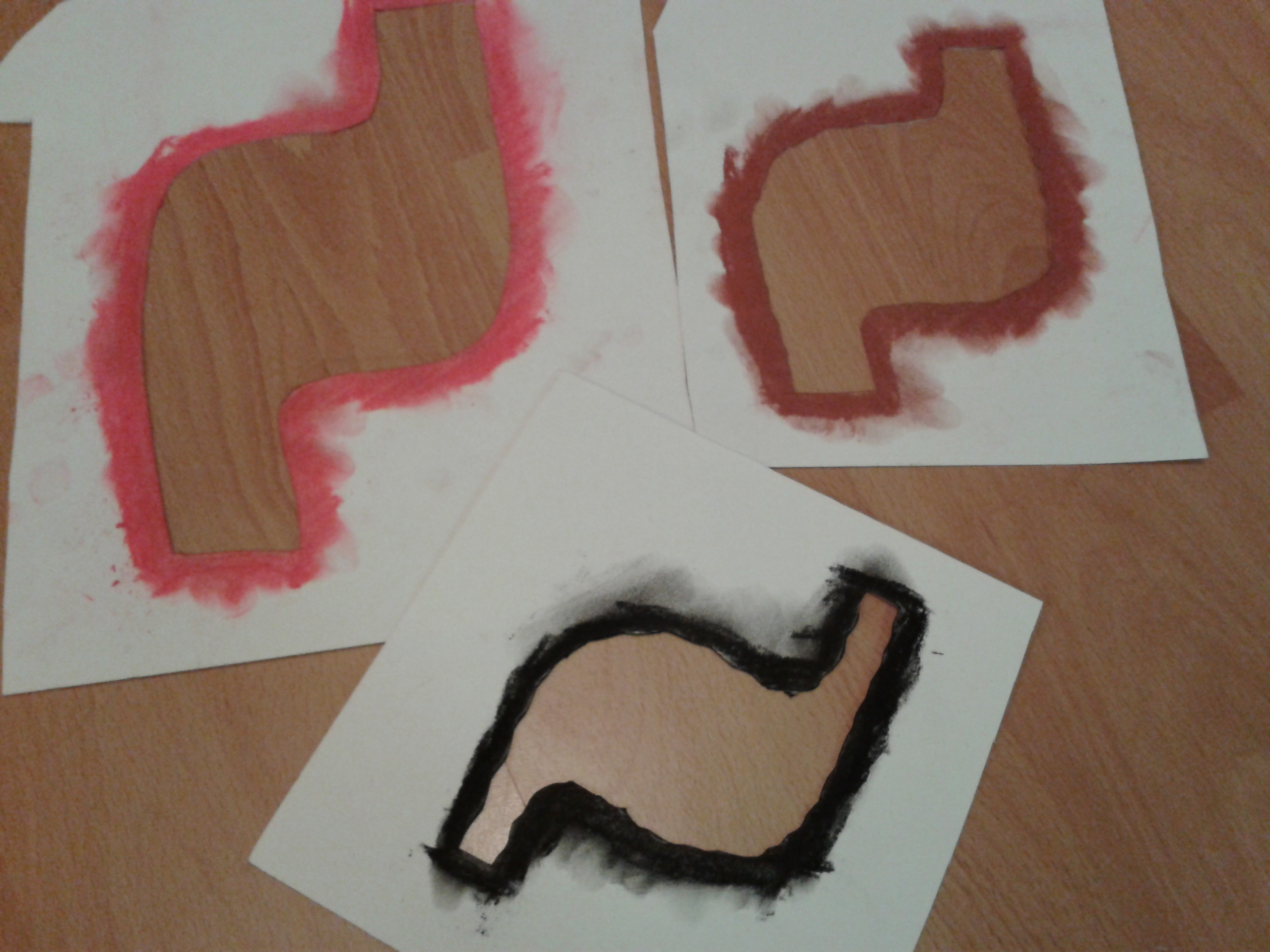
This is a form of stenciling. I haven’t done much research on the matter but I heard once that it is a technique used by certain Inuit Nations. In the process, you cut a stencil and colour around the outside of it with. In my example, I used chalk pastel but I have also used  oil pastel. Other alternatives would be conte, charcoal, or any other smudgable substance.

stomach pic

This is the final image. Can you guess how it’s made?

stencils

Stencils are cut first. Then you colour around the edges of the stencil. Place it on your paper and smudge inwards so that residue from your drawing implement smudges onto the paper. In this example I used the negative space stencil but you can also use the positive stencil and rub outwards. W word of caution: Be careful about the underside of your stencils. Sometimes they get messy and it can transfer to your good paper if you aren’t careful.

Transformation Image – Study of Line and Contrast

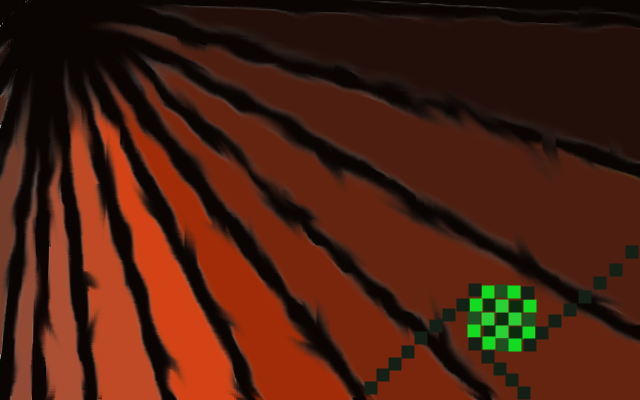
Ok, so I found that when I tried to recreate an idea in my head on GIMP shop, I was getting very frustrated as my limited knowledge didn’t allow me to manipulate the image the way I had intended. So I tried something new. I started by writing all the elements of art on little pieces of paper and put them in a hat. Then I blindly picked one (line). Next I did the same with the principles of art. I ended up picking contrast. So my self assignment was to create an image which explores both line and contrast in such a way that the process doesn’t cause my extreme anxiety but the content evokes anxiety in the viewer.

This is what I came up with.

ununified

In this image organic lines converging at the top left corner direct the viewers attention to the starkly contrasting geometric pattern in the bottom right. I chose these colours as they contrast each other and are somewhat difficult to look at in hope that the viewer would experience mild anxiety.

The process for me was much less stressful and I was able to learn about the smudge effect, how to implement straight lines using various tools (paintbrush, pencil, smudge, eraser, etc.) I explored how using the zoom in and out options in the view tab allow you to fix minor problems as you are able to zoom in to individual pixels.

I’m much happier with this one compared to the previous clock image which was a good learning process but an embarrassment to my artistic abilities. It totally looks like a 1980’s album cover for some crazy techno band…yuck!

Artist Statement

I was inspired to explore the ins and outs of anxiety through my process of art making as well as the content of my image.

In this image I was trying to portray my feelings of anxiety through the imbalance between the organic and the geometric, the opposing colour schemes and the shapes created in the negative spaces between the lines. I hope the audience can look at the image and can think or reflect about the imbalance and the anxiety or stress that is caused by the contrast between the organic and geometric lines and shapes.

One significant artist choice I made before creating this image was to gain inspiration in an experiential way by letting my inspiration unfold as I actualized the content of the image.

A major challenge that I repeatedly struggled with was my limitations using new technology and processes. My skills in image manipulation using the GIMP software aren’t developed enough to actualize my intentions. To deal with this struggle, I broke down the ideas I had for content and approached them in a more basic way using the elements and principles of art and design to show stress between contrasting elements.

I originally chose to use this software program to try and learn a new process. I attended tutorials about the software and practiced on my own. Through trial and error, I learned about many of the tools and functions available through GIMP shop though generalizing these functions from one image to another was sometimes a difficult task.

One of the strengths I have come to realize about myself through this process is my ability to reflect and adapt. Originally, my ideas seemed to outshine my abilities and this created great anxiety in me. Through my reflective practice however, I was able to step back and adjust my image development strategy so that I was dealing with manageable learning objectives each time I began a new image. This process allowed me to deal with my frustration so that learning could continue.

Free write strategy

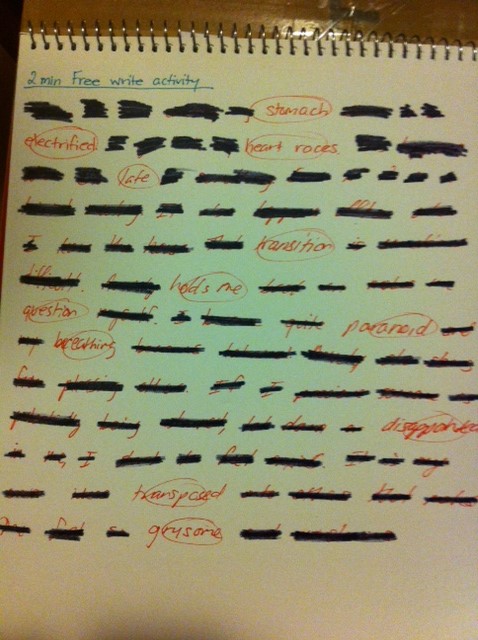
Sometimes when I’m looking for inspiration or when I am trying to get my students inspired I will do a short free write activity. This involve sometimes choosing a topic and setting an alarm for a short amount of time. I usually don’t go more than 2 or 3 minutes. Then I write whatever comes to mind. The pencil can’t stop writing and if I get stuck, I write the topic until I think of something to write or I doodle a bit. Sometimes for my students I will give them 4 or 5 options of starters to get them going. For example, if the topic was bullying, I might give them the following starters. 1) Bullying is…. 2) When I am bullied I feel…. 3) When I see bullying I feel… 4) Bullies are… 5) I am… This might put them in the right direction and if they stumble they can move on to the next starter.

After the 2 minutes are up, I reduce the words to the ones I think are most important. Here is what I came up with.

free write

New Approach!

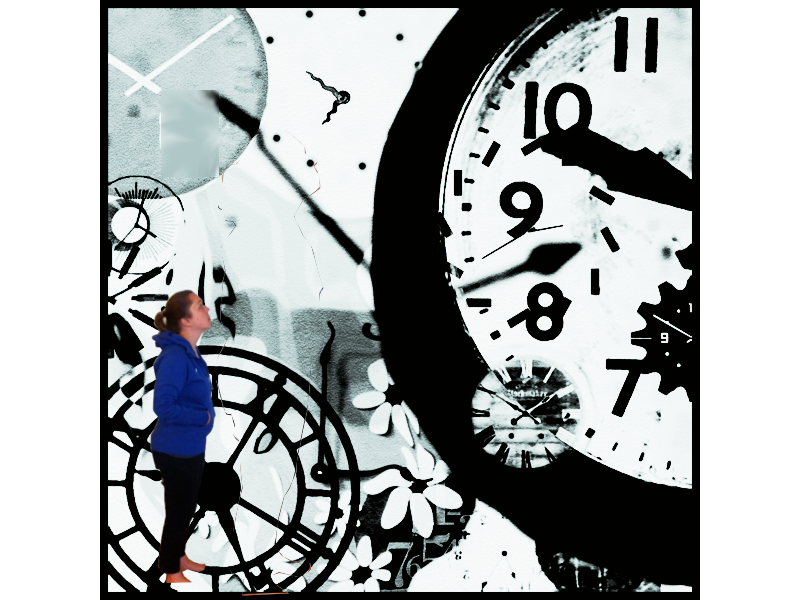
OK, so I’ve realized that my GIMP shop time needs to be kept to small managable sizes or else I am likely to blow. I figure as I learn each of the tools slowly, I’ll become more comfortable with the software and hopefully can spend more time playing around. Until then, I’ll post all the Images I make. Here is the last one.

Transform Clock2 v1


It’s quite literal in content but with this image I was learning how to use filters and effects. I used a light and shadow filter to achieve the glossy look to the background, which ideally would match up more with the highlights on the clock. I also used the merge down function to put the image together.

Oh my goodness!!!

I have been playing around on GIMP shop now and am ready to throw my computer across the room. I NEED a break but before I go. Here are the things I’ve come up with. I’m not yet happy with them and will return after I’ve cooled down.

Transformation2

Similar to the last one but with the portrait selected and scaled down. Unfortunately, I somehow managed to apply a filter to the portrait and can’t figure out how to remove the filter.

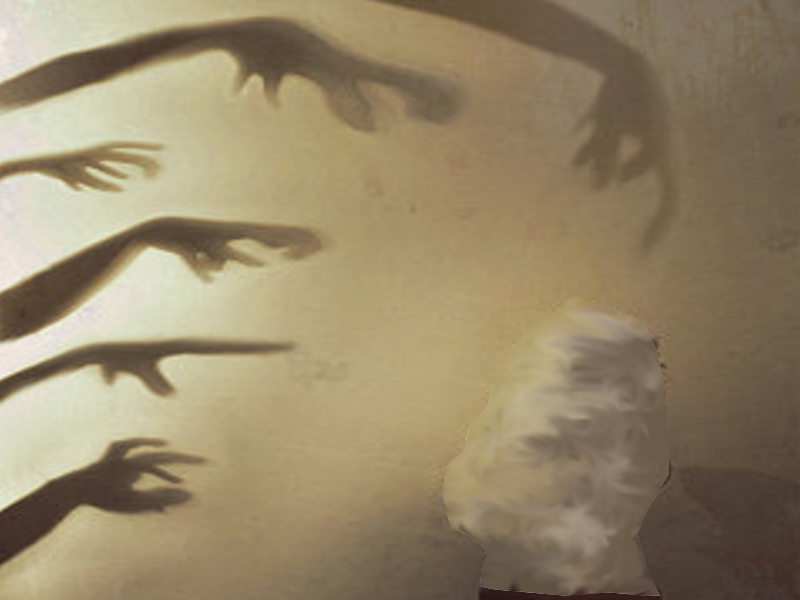
shadow hands v1

In this one I have cut a big portion and used the smudge tool to create the dreamlike haze in the bottom right corner.