
This is a 4 lesson unit plan that focuses on the Earthworks creations of Andy Goldsworthy. Following the Unit plan is a quick presentation about Goldsworthy, some examples of his art, and why he is important to learn about.
SUBJECT: Visual Art 8 GRADE: 8 DURATION: 3-4 classes
Resources and Citations:
Andy Goldsworthy Website: Biography, Philosophy and work
http://www.ucblueash.edu/artcomm/web/w2005_2006/maria_Goldsworthy/biography.html
http://www.morning-earth.org/ARTISTNATURALISTS/AN_Goldsworthy.html
Andy Goldsworthy: Digital Archive
http://www.goldsworthy.cc.gla.ac.uk/
Rivers and Tides: A documentary about Andy Goldsworthy
http://www.youtube.com/watch?v=kGFOLChNOak
Goldsworthy’s Philosophy in his own words
For me looking, touching, material, place and form are all inseparable from the resulting work. It is difficult to say where one stops and another begins. Place is found by walking, direction determined by weather and season. I take the opportunity each day offers: if it is snowing, I work in snow, at leaf-fall it will be leaves; a blown over tree becomes a source of twigs and branches.
Movement, change, light growth and decay are the lifeblood of nature, the energies that I try to tap through my work. I need the shock of touch, the resistance of place, materials and weather, the earth as my source. I want to get under the surface. When I work with a leaf, rock, stick, it is not just that material itself, it is an opening into the processes of life within and around it. When I leave it, these processes continue.
The energy and space around a material are as important as the energy and the space within. The weather—rain, sun, snow, hail, calm—is that external space made visible. When I touch a rock, I am touching and working the space around it. It is not independent of its surroundings and the way it sits tells how it came to be there. In an effort to understand why that rock is there and where it is going, I must work with it in the area in which I found it.
BIG IDEA – Working with the landscape and looking into the heart of nature through creation generates a new and ever growing understanding of place, time, culture, process, materials, and circumstance.
| Desired Results | |
Established Goals (PLO’s)
|
|
| Understandings
Students will understand:
|
Essential Questions
What provocative questions will foster inquiry, understanding and transfer of learning?
|
Students will know:
|
Students will be able to:
|
|
Assessment Evidence |
|
Summative:
|
Formative:
|
|
Learning Plan |
|||||
Lesson& Date |
IRP Outcomes
PLO |
Specific Lesson Outcomes
SLO |
Activities
Teaching Strategies |
Materials/ Resources | Assessment |
| Lesson 1 | Demonstrate a willingness to try unfamiliar materials and processes and adapt familiar ones for unfamiliar uses.
Demonstrate an awareness of safety and environmental considerations related to materials, technologies, and processes.
Create 2D and 3D images that combine and emphasize particular visual elements and principles of art and design.
Analyze 2D and 3D images for their use of particular visual elements and principles.
Create images that incorporate elements from various artists, movements, and periods.
|
Demonstrate a willingness to try unfamiliar materials and processes and adapt familiar ones for unfamiliar uses.
Demonstrate an awareness of safety and environmental considerations related to materials, technologies, and processes.
Create 2D and 3D images that combine and emphasize particular visual elements and principles of art and design.
Analyze 2D and 3D images for their use of particular visual elements and principles.
|
Hook – New Materials – 2 min
After Ss are seated, teacher takes out new materials from box. Teacher can ham it up by acting very excited each time a new material is revealed. Materials may include; rocks, leaves, dirt, sticks, flowers, berries, and a jar of water.
Shape of the day – 2 min Go over together on the board.
Discussion of new Materials – 5 min In seated groups, students discuss the materials presented to them and then a class discussion is developed. Guided questions; 1) What do you see? 2) Are these familiar items? 3) Can art be made of these items? 4) How could you make something that describes a place and time with these items?
Transition – 2 min
Andy Goldsworthy Introduction – 12 min
Transition – 2 min
Elements Trivia – 15 min
Transition – 2 min
Andy Goldsworthy – The elements and principles of art and design. 8 min
Think/Pair/Share – 5 min
1) Was there anything that you saw that surprised or inspired you? 2) How could you use the materials shown at the beginning of the class to demonstrate your understanding of the elements and principles of art and design? 3) Are there other natural materials you would like to try, if so what are they and what might you do with them? 4) What are the most important elements of Goldsworthy’s Earthworks?
Making the criteria – Mind map – 6 min Frontload that we will use this information to determine the criteria for our project.
Criteria discussion – 4 min
Collect permission slips – 3 min Students are asked to hand in the permission slips for the field trips to the site of the project.
Idea development – 10min Students sketch or write in their sketchbooks about ideas they may have developed in order to begin creation of their own Earthworks. Placing emphasis on the elements of art.
Closure – 2 min Remind remaining students to bring permission slips and cameras if they have them but that some will be available if they can’t get one.
|
Box containing bags of sticks, rocks, dirt, flowers, leaves, berries, jar of water
Projector and computer
Elements trivia student sheet x 10. Teacher sheet x 1
Goldsworthy website cued up
Board and marker
Extra permission slips and checklist
Student sketchbooks, extra pencils x 10
|
Formative:
Mind map – Creating criteria
Elements Trivia
Group and class discussion
Independent sketches
|
| Lesson 2 | Demonstrate a willingness to try unfamiliar materials and processes and adapt familiar ones for unfamiliar uses.
Demonstrate an awareness of safety and environmental considerations related to materials, technologies, and processes.
Create 2D and 3D images that combine and emphasize particular visual elements and principles of art and design.
Analyze 2D and 3D images for their use of particular visual elements and principles.
Create images that incorporate elements from various artists, movements, and periods.
|
Demonstrate an awareness of safety and environmental considerations related to materials, technologies, and processes.
Create 2D and 3D images that combine and emphasize particular visual elements and principles of art and design.
Create images that incorporate elements from various artists, movements, and periods.
|
Hook – Rivers and Tides – 2 min
As the students take their seats, the documentary is playing on the overhead.
Criteria – 5 min The teacher has posted the criteria for the project that was planned by the students in the previous class.
Collect permission slips and head to the site (Renfrew Ravine) – 7 min
Front Load – 2 min
Exploration – 5 – 7 min
Exporation – 27 – 30 min
Return to the school – 7 min
Closing – Discussion and Exit slips – 6 min
|
Computer and projector
Criteria poster and rubric x # of students
Permission slips checklist
Charged digital cameras x 2
Student conference checklist
Camera image transfer cord.
Exit slip reflection x # of students
Extension activity for students without permission slips.
First aid Kit
Whistle
|
Formative
Student /teacher conferences
Teacher observation
Earthwork exploration
Class discussion/group about problems and solutions
Exit slip
Summative
Teacher observation
Student teacher discussions
Earthwork Sculpture
Extension activity for students without permission slips
|
| Lesson 3 | Demonstrate a willingness to try unfamiliar materials and processes and adapt familiar ones for unfamiliar uses.
Demonstrate an awareness of safety and environmental considerations related to materials, technologies, and processes.
Create 2D and 3D images that combine and emphasize particular visual elements and principles of art and design.
Analyze 2D and 3D images for their use of particular visual elements and principles.
Create images that incorporate elements from various artists, movements, and periods.
|
Demonstrate an awareness of safety and environmental considerations related to materials, technologies, and processes.
Create 2D and 3D images that combine and emphasize particular visual elements and principles of art and design.
Create images that incorporate elements from various artists, movements, and periods.
|
Intro – 4 min
Class discussion – Ask students if they have any questions that might have arisen after the last class. Reiterate the criteria and go over the rubric one more time.
Transition – 7 min Return to the Renfrew ravine for a working period. Before leaving ask students if they have a camera. Bring a charged digital camera for those who don’t have one.
Working period – 40 min
Transition – 7 min Everyone returns to the school.
Closure – photos and postcards – 7 min
|
Computer and projector
Criteria poster and rubric x # of students
Permission slips checklist
Charged digital cameras x 2
Student conference checklist
Camera image transfer cord.
Exit slip reflection x # of students
Extension activity for students without permission slips.
First aid Kit
Whistle
|
Formative
Student teacher discussions
Teacher observation
Summative
Student Earthworks
Student teacher discussions
Postcards |
| Lesson 4 | Demonstrate a willingness to try unfamiliar materials and processes and adapt familiar ones for unfamiliar uses.
Demonstrate an awareness of safety and environmental considerations related to materials, technologies, and processes.
Create 2D and 3D images that combine and emphasize particular visual elements and principles of art and design.
Analyze 2D and 3D images for their use of particular visual elements and principles.
Create images that incorporate elements from various artists, movements, and periods.
|
Demonstrate a willingness to try unfamiliar materials and processes and adapt familiar ones for unfamiliar uses.
Analyze 2D and 3D images for their use of particular visual elements and principles.
|
Hook: Gallery Walk – 3 min
Shape of the day – 1 min
Hand back Student images – 2 min
Class discussion – Art Criticism – 5 min
1) What materials and processes do you think the artist used? 2) What part of the image immediately catches your eye? Why do you think that is? 3) Which of the elements and principles of art and design are expressed in the image? 4) How does the use of elements and principles of art and design connect the sculpture to the land?
Gallery Walk set up – 2 min
Gallery walk – 15 min
The students are to follow the question prompts for each of their notes.
Transition and pair/share – 5 min
Artist statement guided questions – 3 min Distribute and explain using over head image from the power point document. Now the students have an idea of how the audience will view their art, they can guide the audience’s experience with their artist statement.
Students answer the questions independently – 8 min
Peer edits – 7 min editing – 2 min to look over The students swap their writing with a partner beside them to make suggestions and edits. Then change back to look over the new information
Artist Statements – Move to paragraph form– 6 min Explain that we will have peer edits and I will edit their writing. This activity aligns with the department goal of strengthening student writing but students will only be graded on idea development and their evaluative process, not grammar or writing skills. The students transform their answers from point form to paragraph form to create an artist statement.
Closure – What did you learn? Write and share – 4 min Students write 4 sentences about things they learned in the unit. It can be about the environment, making sculptures, the elements and principles of art and design, Andy Goldsworthy, working in nature, place, time, circumstance, or themselves as an artist. Share a few with your table group Teacher asks for some volunteers to share out.
Clean up and hand in –2 min Students are to hand in their artist statements, guided artist statement questions, their image and their learning summary for grading. Grades will be ready in 1 week.
THANK THE STUDENTS ON A UNIT WELL DONE!!!!
|
All students’ printed images from the previous class
Projector
Computer
Gallery walk file 4 different coloured post-it notes x # of students
Artist statement guided questions x # of students
Artist statement paragraph x # of students. |
Formative
Summative
|
Assessment
1) Demonstrate a willingness to try unfamiliar materials and processes and adapt familiar ones for unfamiliar uses.
Formative
- Day 1 – Hook to Group discussions – In table groups, students have a 5 min discussion about the materials (sticks, rocks, leaves, berries, water, grass, dirt) presented in the lesson hook. Questions to consider; 1) What materials do you see? 2) Can art be made of these items? 3) How could you make something that describes a place and time from these items?
- Day 2 – Student/Teacher Conference – As students are working, teacher visits each student to ask questions pertaining to their materials and processes.
Summative
- Day 3 – Peer analysis through gallery walk – Students analyze the work of their peers and answer questions pertaining to materials and processes. Their ideas and advise are considered in their final grade based on the criteria the students made for the project.
- Day 3 – Learning log – Students write about what they learned as a closing activity.
2) Demonstrate an awareness of safety and environmental considerations related to materials, technologies, and processes.
Formative
- Day 1 – Collaborative criteria creation through mind map – Students work as a class to create criteria for the project. If they do not come to it on their own the teacher must make sure to ask guided questions that lead the students to issues regarding environmental sensitivity as one part of the criteria.
Summative
- Day 2 – Teacher observations and Student/Teacher conferences – As students are working, teacher visits each student to ask questions pertaining to their process as it pertains to environmental sensitivity.
3) Create 2D and 3D images that combine and emphasize particular visual elements and principles of art and design.
Formative
- Day 1 – Elements Trivia – Students participate in a trivia game which acts as a review of the elements and principles of art and design. A few questions also pertain to the elements of the Earth; wind, fire, water, earth
- Day 1 – Class discussion – Students participate is group and class discussions about the elements and principles of art and design.
- Day 1 – Students sketch preliminary ideas for their Earthwork.
Summative
- Day 2 – Earthworks – Students create and document their own Earthworks with a focus on one or more of the elements and principles of art and design.
4) Analyze 2D and 3D images for their use of particular visual elements and principles.
Formative
- Day 1 – Analyzing Goldsworthy’s work – Students look at a power point presentation and discuss the use of the elements and principles of art and design in Goldsworthy’s creations.
Summative
- Day 3 – Guided Gallery walk – Students analyze the work of their peers by examining their use of the elements and principles of art and design.
- Day 3 – Artist Statement Guided questions – Students analyze their own use of the elements and principles of art and design while writing an artist statement.
5) Create images that incorporate elements from various artists, movements, and periods.
Formative
- Day 1 – Think/Pair/Share – After the power point presentation, students discuss the work of Andy Goldsworthy. The conversation is guided by questions on the projector. A) Was there anything that you saw that surprised you? B) How could you use the materials shown at the beginning of class to demonstrate your understanding of the elements and principles of art and design? C) Are there other natural materials you would like to try, if so what are they and how might you use them? D) What are the most important elements of Goldsworthy’s Earthworks?
Summative
- Day 2 – Student Earthworks – The students use the inspiration and philosophy from Goldsworthy’s work to create their own Earthworks.
- Day 3 – Guided Artist Statements – Students answer a handout of questions that is designed to aid them in the creation of an artist statement. Among others, students answer this question; What part of Andy Goldsworthy’s philosophy have you attempted to achieve though your Earthwork? Explain your reasoning.
The Rubric – On day one, students collectively make a mind map of Goldsworthy’s philosophy and their goals in creating similar Earthworks. This information is used to make a rubric which is presented to the students on Day 2.
Andy Goldsworthy – Earthworks
About Goldsworthy
Born in 1956 in Cheshire, England
Raised in Yorkshire, England
Bradford Art College 1974–1975
Lancaster Art College 1975–1978
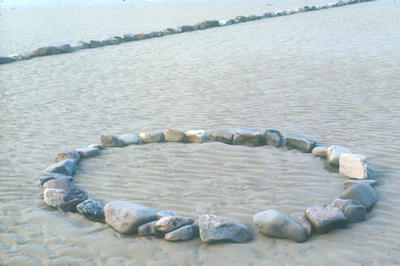
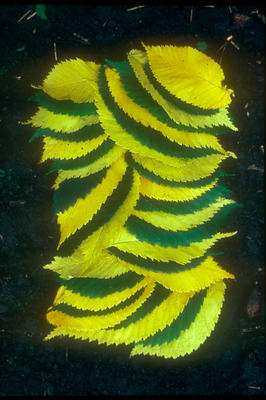
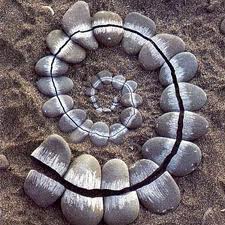
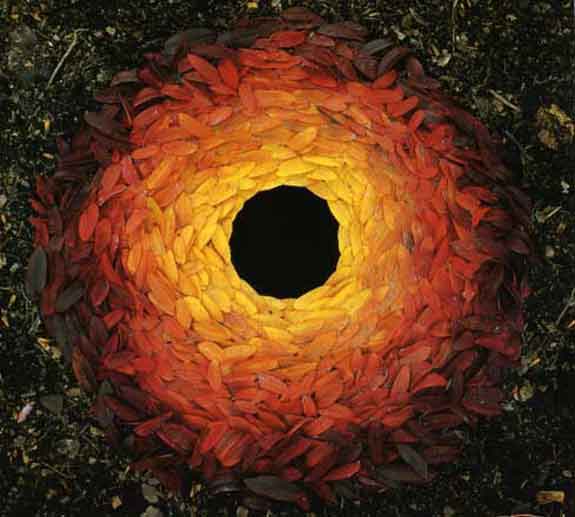
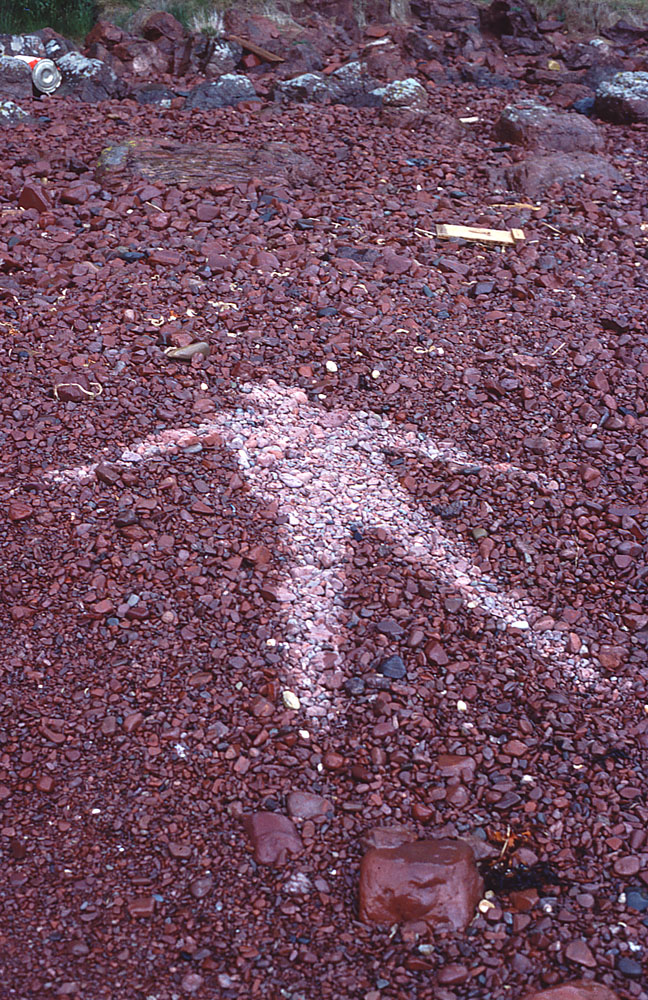
Andy Goldsworthy is an extraordinary, innovative British artist whose collaborations with nature produce uniquely personal and intense artworks. Using a seemingly endless range of natural materials—snow, ice, leaves, bark, rock, clay, stones, feathers petals, twigs—he creates outdoor sculpture that manifests, however fleeting, a sympathetic contact with the natural world. Before they disappear, or as they disappear, Goldsworthy, records his work in suburb color photographs.
Goldsworthy deliberately explores the tension of working in the area where he finds his materials, and is undeterred by changes by changes in the weather which may melt a spectacular ice arch or wash away a delicate structure of grasses. The intention is not to “make his mark” on the landscape, but rather to work with it instinctively, so that a delicate scene of bamboo or massive snow rings or a circle of leaves floating in a pool create a new perception and an ever growing understanding of the land.
Philosophy
For me looking, touching, material, place and form are all inseparable from the resulting work. It is difficult to say where one stops and another begins. Place is found by walking, direction determined by weather and season. I take the opportunity each day offers: if it is snowing, I work in snow, at leaf-fall it will be leaves; a blown over tree becomes a source of twigs and branches.
Movement, change, light growth and decay are the lifeblood of nature, the energies that I try to tap through my work. I need the shock of touch, the resistance of place, materials and weather, the earth as my source. I want to get under the surface. When I work with a leaf, rock, stick, it is not just that material itself, it is an opening into the processes of life within and around it. When I leave it, these processes continue.
The energy and space around a material are as important as the energy and the space within. The weather—rain, sun, snow, hail, calm—is that external space made visible. When I touch a rock, I am touching and working the space around it. It is not independent of its surroundings and the way it sits tells how it came to be there. In an effort to understand why that rock is there and where it is going, I must work with it in the area in which I found it.

Rational
The big idea: Working with the landscape and looking into the heart of nature through creation generates a new and ever growing understanding of place, time, culture, process, materials, and circumstance.
The students learn about Andy Goldsworthy and his art in order to expand their ideas of what art is and to gain an appreciation of how art isn’t only made for museums. It allows them to explore and work with nature in an attempt for them to grow more connected with nature.
Through this exploration they will work with familiar materials in an unfamiliar way and an emphasis is placed on the importance of environmental sustainability. The work of Andy Goldsworthy is analyzed for his use of the elements and principles of art and design. The students will use this new knowledge to build on their understanding of the elements and principles and their knowledge will manifest in their own Earthwork creation.
PLOs to be assessed: From the Grade 8 IRP for Visual Art
1) Demonstrate a willingness to try unfamiliar materials and processes and adapt familiar ones for unfamiliar uses.
2) Demonstrate an awareness of safety and environmental considerations related to materials, technologies, and processes.
3) Create 2D and 3D images that combine and emphasize particular visual elements and principles of art and design.
4) Analyze 2D and 3D images for their use of particular visual elements and principles.
5) Create images that incorporate elements from various artists, movements, and periods.
Recent Comments