
Colour theory
Colour, being one of the elements and principles of art and design, is a lesson that needs a strong foundation of understanding. In class this week we learned about introducing colour theory to our students. In our lesson we learned a little bit about colour in a teacher centered tutorial and moved on to a student centered activity that was very open. We were encouraged to use various materials and had paint available to us. The variety of images made from this open concept lesson was very nice to see as everyone took what they knew and expanded on it. In a lesson I planned and executed during my practicum, I had the students paint a colour wheel and some of them were very successful but others were quite frustrated. Jan pointed out that this is often the case. Because of this, I will adapt future lessons to make this a more successful lesson for all the students. Taken from the grade 8 visual arts IRP, the following PLOs would be the focus for the lesson; Analyze how individual physical elements of art and design are used to create meaning in images and Create images that support or challenge personal and societal beliefs, traditions, values, or practices.
To introduce the lesson of colour theory, I would hand each table group a handful of trinkets; hairbrushes, small toys, pens, ornaments, elastics, etc. Each table group would be asked to arrange the objects by colour. There would be no stipulation as to how to arrange them. Because of this some students might choose to arrange them in warm and cool colours. Others might take a rainbow approach. Perhaps some would arrange them according to the number of different colours that appear on any given object. The important thing is that the students play with the idea of colour. Next, we would go through a short colour theory tutorial on colour theory where they would be introduced to the colour wheel, and colour terminology like monochromatic, primary/secondary/tertiary colours, analogous colours, etc. I would then ask the students to swap tables so they have a new set of trinkets and design a colour wheel using the objects. Students return to their seats and are given the topic of the lesson; Cultural traditions, beliefs, values, and practices. A class discussion led by guided questions would temporarily change the focus to the students’ cultures. After the discussion, the students would be asked to write in their sketchbooks about their ideas of their own cultural traditions, beliefs, values and practices. I would leave this quite open and allow the students to write about school culture, cultural heritage, sports culture that interests them. I want them to be invested in something they enjoy so cultural heritage isn’t necessarily the main focus. After this we would do a grouping activity. A 12 colour colour-wheel with the 12 months of the year would be placed on the board. Students would form a line based on the month in which they were born. Groups of 4 would be made. In their groups, students would discuss the idea of cultural colour symbols. For example, in Thailand, red is the colour of Sunday. In China, red represents weddings. Students would then be given a big piece of paper and a specific coloured marker. They would then list all the colour symbols they could think of that are represented by that colour. The class would have a gallery walk to see what everyone came up with. We would have a short class discussion about any surprises or questions they might have. Students would then return to their sketchbooks when they wrote about their culture. I would ask each student to circle important words that stand out from their writing. After this, possibly in the following class, we would spend time creating a piece of artwork that used the ideas gleaned from the formative activities to make a non-representational painting and a short artist statement. Students would be graded on their image, based on the development of their ideas around cultural traditions, values, beliefs, and practices as well as their growing understanding of colour theory. The artist statement will serve as an integral piece to determine their summative grade.
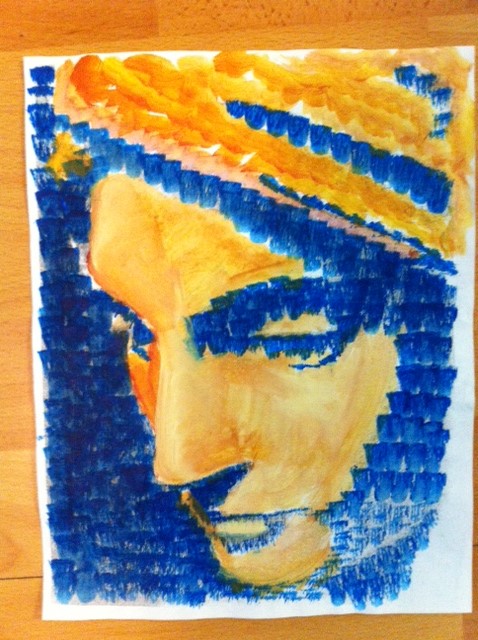 For this we used a photocopy of this image which had been reduced to very light grey. We used it to paint over. This is a highly successful art activity for those who are being introduced to colour as an element of art. The focus can be placed on different colour schemes like primary colours, monochromatic, Secondary or tertiary, complimentary, analogous.
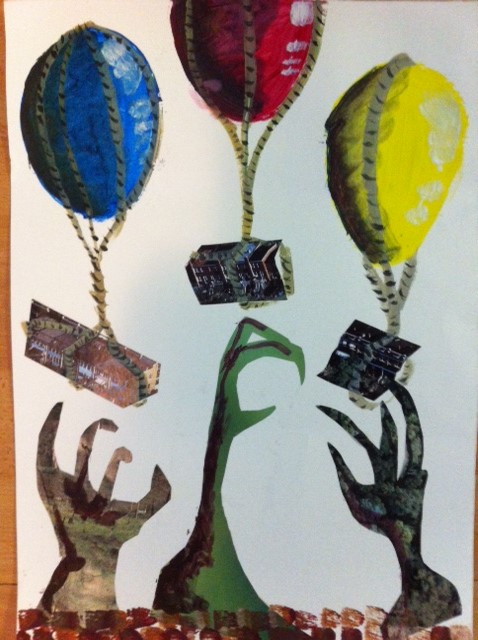
This was a very open activity and might require more structure in the classroom. We were simply asked to explore colour using whichever media we desired. I chose acrylic paint and collaged images from a magazine.
Recent Comments