
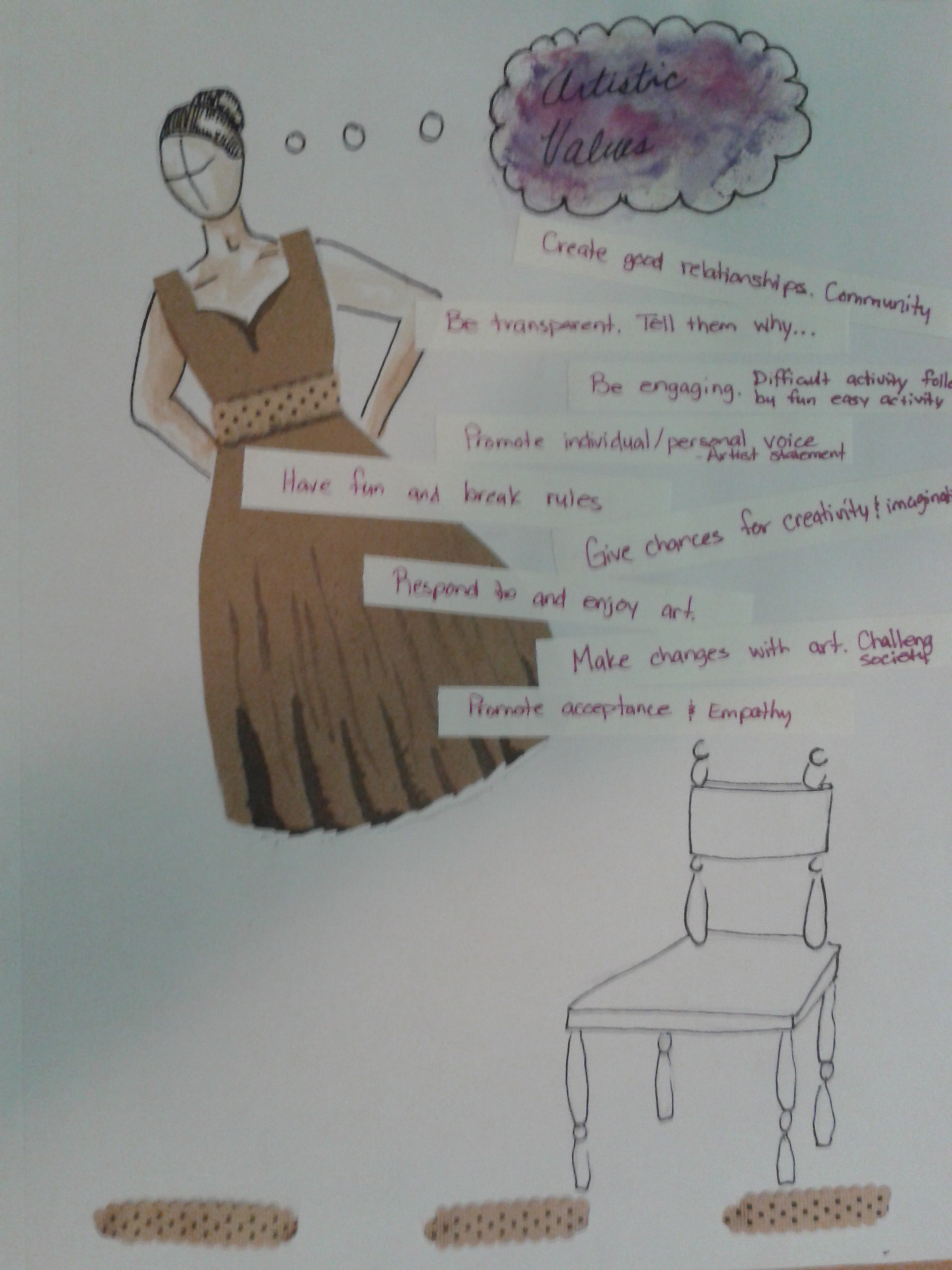
At the end of my 401/402 semester my faculty associate had me reflect on my own personal artistic values for my students and myself. The key things I came up with were to create good relationships incorporating community. I always want to be transparent with my students so they understand why these values are important. Art teachers need to be engaging and to do so can follow a difficult activity with an easier more enjoyable one. I think it is important to promote individuality and personal voice though also fostering acceptance and empathy. As the teacher, I need to let the students have fun and allow them to break a few artistic rules along the way.
As I continued classes through this last semester my philosophy and approach to art education has grown considerably. Three of the areas that I feel have developed since the beginning of the designs for learning art class are inclusion in the art room, community and place based education as well as assessment.
When I was in my practicum, I took differentiated lessons very seriously, making adaptations for students who required different tools to feel successful. I had a student in my art 9 class who attended the class with an educational assistant whom I discussed his IEP with and made small activities for him so he could be art making in class too though I wasn’t focused on him being able to communicate with his art. Often the lessons were simple step by step processes that gave him something to do but didn’t really encourage him to express his feelings or ideas. I admit that on occasion, I would see the EA helping or to be more specific, doing the art projects for him if they were too difficult. I assumed that the EA would tell me how to teach him. After week ten of this semester, I came to a realization that I will carry with me into my career. As the classroom teacher, he was my student, not the EA’s. It was my responsibility to find out explicitly, what types of activities he could do and how activities could be adapted for him to feel like he was expressing himself as opposed to just completing the steps of the differentiated lesson I had planned. As stated in the reading, The Art of Inclusion, “True inclusion means offering each student the opportunity to learn in a style and environment that maximizes his or her ability to fully develop as a human being.” Equipped with this knowledge and a growing understanding of good inclusive practices, in the future, I will take more time to collaborate with life skills teachers on the methods that the students communicate. Using this information, I can design more fulfilling art activities that encourage more authentic communication. Doing this is also great modeling for other students in the class and encourages them to express themselves as well as appreciate others’ work and ideas.
Place based education is another burgeoning idea I have had this semester. I feel that as an art teacher, I have the unique opportunity to infuse the sometimes obscure ideas of privilege and power to students in the classroom. This year in PDP, we have been learning a lot about Aboriginal Education and one of the goals I have taken on as an educator is to decolonize education. One way I can see this possibility is through place-based education that focuses on immediate location to draw on connections that we have to the land. Current and historical connections can be assessed and in doing this I hope to encourage my students to use environmentally sensitive practices while appreciating different cultures and their ties to the land. “Art education framed by a critical pedagogy of place creates opportunities for students to engage in thinking and artmaking that considers vital questions about nature, place, culture and ecology.” If I can infuse my lessons with critical thinking, eco-justice, and acceptance (not tolerance) of different cultures, I feel like I will be able to open up educational doors for Aboriginal and non-Aboriginal students to learn about one another and appreciate each others’ strengths.
As a new teacher, assessment is always at the forefront of my development. Art teachers have a unique assessment opportunity that allows us to base our assessment on process instead of product. I think that curriculum reform is developing in other subjects to allow for this as well but somehow currently, it seems more acceptable in the art room. Throughout both the portfolio project and the transformation project, Jan has impressed on us several times that it is not the product that she is interested in but the process and the thinking that went into them. This will be something that I stress to my students in my upcoming position as a grade 8 and 9 art teacher. This type of assessment practice will also help students who need differentiated instruction because it doesn’t require all students to create the same thing. It requires them to explore their thoughts and communicate their feelings through creation. Eisner said, “What needs attention in assessment and evaluation is not only manifest of behaviour, but also the kind of thinking that went into the project”. Some things I can do to encourage this are to have an ongoing sketchbook activity that allows students to keep track of their ideas in order to build upon them. Another thing I will do, which was recommended by Jan in class, is to ask the students to write a note to me before I assess their work which points out the things the student wants me to notice. I can also elaborate on that by asking the students to explain why it is important for them that I take note of these particular aspects.
Going into the workforce as a teacher is both exciting and scary but as long as I continue to reflect on my growing educational philosophies in inclusion, creating community through art, assessment practices and other areas, I will continue to grow as an artist, art educator, and lifelong learner. Professional development opportunities and collaboration with other educators will aid in this development as well as my own understanding of my students and the community I work and live in.
Recent Comments